I Tested 6 Gluten-Free Flour Blends So You Can Stop Guessing (And Stop Wasting Money)

I Tested 6 Gluten-Free Flour Blends So You Can Stop Guessing (And Stop Wasting Money)
Here's a confession that might cost me some brand partnerships: most gluten-free flour blends are mediocre. Not terrible. Not inedible. Just... fine. And "fine" is expensive when you're paying $8 for a bag of rice flour and potato starch that a competent food scientist could have formulated in an afternoon.
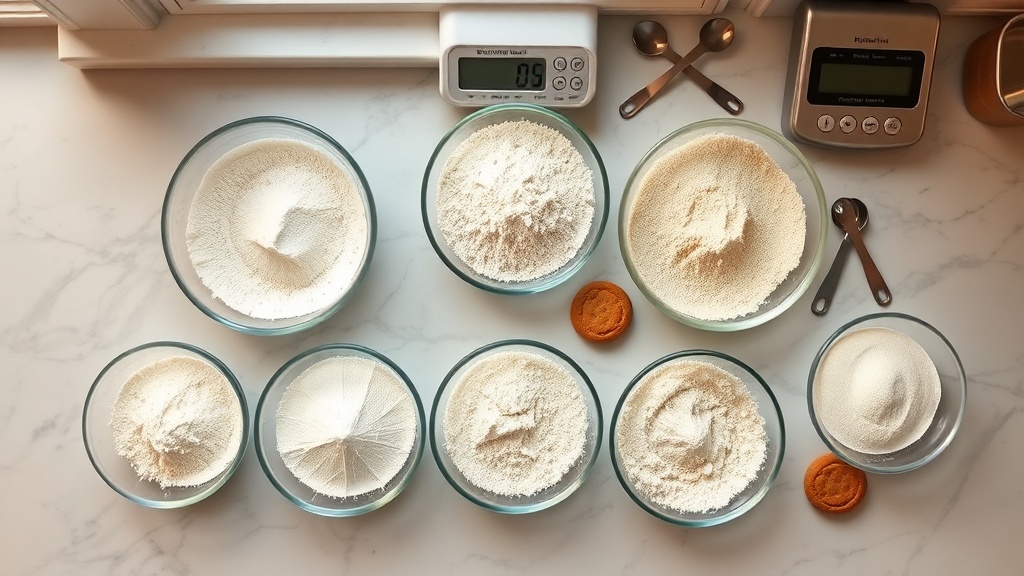
I've spent the last several months running six popular all-purpose GF blends through my Texture Lab — same recipes, same oven, same technique — because I was tired of the "just use 1-to-1!" advice that ignores the fact that these blends perform wildly differently depending on what you're baking. A blend that nails pancakes can absolutely bomb a pie crust.
So here's the honest breakdown. No sponsorships. No affiliate links masquerading as objectivity. Just flour, a kitchen scale, and my unreasonable standards.
The Testing Protocol
Every blend got the same three tests:
- Chocolate chip cookies (butter-heavy, needs spread and chew)
- Banana muffins (quick bread, needs dome and tender crumb)
- Pizza dough (yeast-risen, needs structure and some stretch)
All recipes measured by weight (because if you're still using cups with GF flour, we need to have a separate conversation). Same xanthan gum ratio for blends that don't include it. Same oven at 375°F, calibrated with a thermometer because I don't trust appliances.
The Contenders
Bob's Red Mill 1-to-1 Baking Flour
Price: ~$0.12/oz | Includes binder: Yes (xanthan gum)
The Honda Civic of GF flour. Reliable, available everywhere, and nobody's going to be impressed at a dinner party when you mention it. But here's the thing — reliability matters more than glamour when you're baking three times a week.
Cookies: Good spread, decent chew, slightly grainy finish if you really pay attention. 7/10.
Muffins: Solid dome, tender crumb, unremarkable flavor. 7.5/10.
Pizza dough: Passable. Holds together, browns okay, but the crust is more "sturdy cracker" than "pizzeria." 6/10.
The verdict: Your everyday workhorse. It won't embarrass you, and at this price point, you can actually afford to bake regularly without calculating the cost per muffin. If you're new to GF baking and overwhelmed by options, start here. You can get fancier later.
King Arthur Measure for Measure
Price: ~$0.15/oz | Includes binder: Yes (xanthan gum)
King Arthur has been milling flour since before the Civil War, and that institutional knowledge shows. Their superfine grind is noticeably smoother than Bob's — pick up a handful of each and you'll feel the difference immediately.
Cookies: Beautiful. Tender, even spread, barely any grittiness. This is where the extra three cents per ounce actually matters. 8.5/10.
Muffins: Lovely dome, delicate crumb, slightly better browning than Bob's. 8/10.
Pizza dough: Similar to Bob's — adequate but not exciting. The finer grind doesn't help much with yeast doughs. 6.5/10.
The verdict: The upgrade pick for anyone who bakes cookies and cakes regularly. The textural difference is real, especially in butter-forward recipes where grittiness has nowhere to hide. Worth the premium if pastry is your thing.
Cup4Cup Original Blend
Price: ~$0.28/oz | Includes binder: Yes (xanthan gum)
Developed by a former Thomas Keller chef, and priced like it. Cup4Cup includes milk powder, which is both its superpower and its limitation. That dairy addition creates richer browning and a more "wheaty" flavor than any other blend I've tested.
Cookies: Exceptional browning, rich flavor, almost indistinguishable from conventional flour cookies if you're not actively looking. 9/10.
Muffins: Gorgeous. The milk powder gives them a bakery quality that other blends can't touch. 9/10.
Pizza dough: Actually impressive — the milk powder helps with browning and the crust has more flavor depth. 7.5/10.
The verdict: If money is no object and you don't have a dairy sensitivity, this is the best-performing blend on this list. Full stop. But let's talk about that price — at $0.28/oz, a simple batch of cookies costs roughly twice what it would with Bob's. And the milk powder means dairy-free bakers (a significant chunk of the Celiac community, since lactose intolerance and Celiac love to travel together) are completely shut out. That's not a minor asterisk.
Namaste Perfect Flour Blend
Price: ~$0.10/oz | Includes binder: Yes (xanthan gum)
The budget champion. Namaste uses brown rice flour, tapioca starch, and arrowroot — a simpler formula that keeps costs down. It's also free from dairy, soy, corn, and nuts, which makes it the most inclusive blend here.
Cookies: Decent spread, slightly more rustic texture. Fine for Tuesday night cookies, not what I'd bring to a bake sale. 6.5/10.
Muffins: Good dome, slightly coarser crumb. Perfectly acceptable. 7/10.
Pizza dough: Surprisingly decent — the brown rice flour base gives it a nuttier flavor that works with pizza. 6.5/10.
The verdict: If you bake often and your grocery budget is already stretched thin from the GF Tax on everything else in your cart, Namaste is honest flour at an honest price. It won't win any beauty contests, but it feeds you without financial guilt. I respect that.
Better Batter Original Blend
Price: ~$0.18/oz | Includes binder: Yes (xanthan gum)
The cult favorite of the GF bread-baking community, and after testing it, I understand why. Better Batter's starch ratio is calibrated for structure — it wants to be bread.
Cookies: Fine. Not its strength. Slightly starchier than I prefer, with a more cakey chew instead of a proper cookie chew. 6.5/10.
Muffins: Good but unremarkable. 7/10.
Pizza dough: Here we go. Actual stretch. Real structure. A crust that you could fold without it shattering into crumbs. This is what I've been missing. 8.5/10.
The verdict: If you're primarily a bread baker — sandwich loaves, pizza, focaccia — Better Batter is the answer to a question the other blends aren't even asking. It's mediocre at delicate pastry, but for anything involving yeast and structure, it outperforms everything else on this list. Sometimes specialization beats versatility.
Anthony's Premium Gluten-Free Blend
Price: ~$0.11/oz | Includes binder: Yes (xanthan gum)
The newer kid on the shelf. Anthony's has built a following with their bulk-friendly sizing and surprisingly fine grind for the price point.
Cookies: Solid performance, comparable to Bob's. 7/10.
Muffins: Good dome, clean flavor, smooth crumb for a budget blend. 7.5/10.
Pizza dough: Similar to Bob's — functional but not exciting. 6/10.
The verdict: If Bob's Red Mill is the Honda Civic, Anthony's is... also a Honda Civic, but you bought it at a slight discount because you were smart enough to buy the bigger bag. Genuinely comparable quality at a lower per-ounce price. The main downside is availability — you're ordering this online, not grabbing it at the grocery store.
The Real Recommendation (It's Not Just One Blend)
Here's what nobody in the flour-blend-comparison industrial complex wants to tell you: you probably need two blends.
One for everyday baking (cookies, muffins, pancakes, quick breads) and one for structured baking (bread, pizza, anything involving yeast). Trying to make a single blend do everything is like using a chef's knife to peel garlic — possible, but why are you making this harder?
My two-blend system:
- Everyday: King Arthur Measure for Measure (or Bob's Red Mill if budget matters more)
- Bread/pizza: Better Batter Original
If you can only buy one — and I get it, the GF Tax is real — go Bob's Red Mill 1-to-1. It's the B+ student at everything and the most widely available. No shame in that.
And if someone tells you Cup4Cup is "worth it" without mentioning that it costs nearly three times what Bob's does and excludes dairy-free bakers, they're either not paying for their own flour or not thinking about the full community. Exceptional product. Problematic recommendation.
A Note About "1-to-1" Claims
Every blend on this list claims to be a 1:1 substitute for all-purpose wheat flour. This is... aspirational. They're closer to 0.85-to-1 in most applications, and the moisture absorption is different enough that you'll want to adjust hydration in any serious recipe.
Start with the recommended ratio, then learn your blend's personality. Does it drink water? Add a tablespoon more liquid. Does it stay wet? Hold back. Every blend has quirks, and pretending otherwise is how people end up with hockey puck scones and blame themselves instead of the marketing copy.
The Price Reality
Let's do some math that GF flour companies would prefer you didn't think about:
| Blend | Cost for 24oz | Cost per batch of cookies (~12oz flour) |
|---|---|---|
| Namaste | $2.40 | $1.20 |
| Anthony's | $2.64 | $1.32 |
| Bob's Red Mill | $2.88 | $1.44 |
| King Arthur | $3.60 | $1.80 |
| Better Batter | $4.32 | $2.16 |
| Cup4Cup | $6.72 | $3.36 |
Conventional all-purpose flour? About $0.60 per batch. The GF Tax on flour alone is 2x to 5.5x. And that's before we talk about the xanthan gum, the specialty eggs, the everything else. This is why I include price in every review and why I will never apologize for recommending budget options alongside premium ones. Being Celiac is expensive enough without pretending that cost doesn't matter.
Every blend was purchased at full retail price with my own money. No brand sent me free product, and if they had, I would have told you. My Texture Lab runs on obsession and a kitchen scale, not sponsorships.