The Psyllium Husk Secret: Why Pro Bakers Use It—And How You're Probably Doing It Wrong

Professional bakers don't talk about psyllium husk in terms of wellness. They talk about it in terms of water activity, viscosity curves, and gel formation rates. That's the conversation I want to have—because if you've been dumping a tablespoon into your loaf and calling it a day, you've been doing the chemistry wrong.
Let me give you the real framework.
The Misunderstanding That's Ruining Your Bread
The confusion that trips up most home bakers coming from conventional baking: psyllium husk does not replace gluten. I know. Every recipe header says "this is what gives GF bread its structure!" And structurally, that's not wrong—but it's incomplete in a way that destroys your results.
Gluten does two distinct things. First, it forms an extensible protein network that traps CO₂ from fermentation. That's elasticity. Second, and what most people forget, gluten regulates how the dough hydrates—it controls the rate and distribution of water absorption, acting as a hydration buffer during mixing.
Psyllium husk is not elastic. It doesn't form a protein network. What it does is form a thick, viscous gel when hydrated—a mucilage layer that increases the apparent viscosity of the dough, slows water migration between starches, and (to a limited degree) provides cohesion by making the dough sticky enough to hold together during proofing and oven spring.
Viscosity ≠ elasticity. This is the central confusion. Viscosity resists flow. Elasticity returns to shape after deformation. Your GF loaf needs both, which is why psyllium husk is necessary but not sufficient—it's the hydration management layer, not the structural backbone.
When you understand this, the failures start making sense. Why does your loaf collapse after coming out of the oven? Insufficient structure. Why does it gummy out in the middle? Over-hydration that psyllium amplified rather than controlled. Why does it crumble on slice? You either under-gelled the psyllium or your starch-to-protein ratio in the flour blend is off. (This is why understanding gluten-free bread texture formulas matters—texture isn't an accident.)
The ingredient isn't the problem. The mental model is.
Type Matters More Than Brand
This is the one that makes me want to put up a warning label at every Whole Foods checkout. Most home bakers—I was guilty of this my first year post-diagnosis—buy whatever psyllium husk product is in the supplement aisle. Fiber supplement. Big jar. Pours like dust. Looks like it should work.
The problem: ingredient labels hide more than they clarify. (The same issue that plagues everything you buy—check out what's actually hiding in your pantry if you want a primer.)
What's actually in those jars varies:
Whole psyllium husks — The intact outer seed coat of Plantago ovata. Lower surface area than ground powder. Slower, less uniform gel formation. Better for adding some texture without aggressively binding moisture. (This is the version sold as "coarse" in some baking suppliers. It absorbs water, but slowly and unevenly.)
Psyllium husk powder — Ground husks. Higher surface area. Faster, more uniform gel formation. This is what professional kitchens use for bread applications. Not the supplement capsule contents. Not a fiber drink mix. Pure, unflavored, food-grade psyllium husk powder with no additives.
Fiber drink products — Products like Metamucil vary significantly by formulation—some contain sugars, artificial flavors, and additives like citric acid. Any product with added sugars or flavors introduces hydration competition (sugar competes for water absorption) and flavor bleed-through you'll taste in the finished loaf. Always read the ingredient list: some plain fiber supplement products are nothing but psyllium husk and are fine for baking; others are not. If you're not sure what's in the jar, check before baking.
The organic markup question: Psyllium is grown primarily in India and there is a meaningful organic certification pipeline, but the functional chemistry of organic vs. conventional psyllium husk powder is identical for gel-formation purposes. If you're buying organic psyllium husk powder for baking, you're paying for your conscience, not your loaf. I'm not telling you what to do with your money—I'm telling you what the chemistry says.
For bread applications: fine-ground psyllium husk powder, unflavored, no additives. That's the spec. Buy it.
The Ratio Framework: What the Numbers Actually Say
Professional bakers use a flour-weight percentage approach for hydrocolloids. It's the same logic as baker's percentage for yeast and salt—everything is calculated against the total flour weight. For psyllium husk powder in gluten-free bread, the commonly cited working range is 2–3% by flour weight, though published formulations and professional recipes vary, and your actual target will depend heavily on your specific flour blend.
What follows is from my own test batches across three flour blend bases. These are personal observations from my kitchen—not controlled studies—so treat them as starting points for your own iterations rather than universal rules.
Test Blend A: 60% white rice flour / 40% tapioca starch (high starch, typical commercial GF blend)
| Psyllium % | My Result |
|---|---|
| 1% | Crumbly, poor cohesion, collapsed after cooling |
| 2% | Acceptable structure, slight gumminess in center |
| 3% | Good crust, cohesive crumb, slight over-chew |
| 4% | Dense, gummy center, heavy and wet-feeling |
Test Blend B: 40% sorghum / 30% millet / 30% arrowroot (whole grain forward, higher protein—whole grains behave differently than starches in your dough)
| Psyllium % | My Result |
|---|---|
| 1% | Better than Blend A at same ratio—whole grain proteins provided some backup structure |
| 2% | Best result in this blend: open crumb, good spring, clean slice |
| 3% | Over-bound, tight crumb, good structure but lost lightness |
| 4% | Gummy, over-hydrated core |
Test Blend C: 50% almond flour / 25% tapioca / 25% arrowroot (low-starch, high fat)
| Psyllium % | My Result |
|---|---|
| 1% | Falls apart entirely—fat from almond interfered with gel formation |
| 2% | Passable but dense, behaved more like a quick bread |
| 3% | Best result in this blend, but still not a lean-bread analog—fat is the dominant variable |
| 4% | Not worth testing |
The pattern I observed: starch-heavy blends seem to want 2–2.5%, whole grain blends often work better at the lower end around 2%, and fat-heavy blends may require 3% or more because fat coats water before psyllium can gel it. Your specific flour brands and ratios will shift these numbers—this is a starting framework, not a formula you can copy-paste.
A reasonable place to start: 2% by flour weight. If you're working with a starch-dominant commercial blend and still getting gumminess, try pulling back toward 1.75%. If you're working with a high-fat or nut flour blend, try 3% and reduce total hydration by 5–10%. Document everything. This is iterative.
When It Fails: The Four Failure Modes
1. Over-hydration spiral
Psyllium husk gel holds water extremely well—which means if your total recipe hydration is high and you're adding psyllium, you will trap that moisture in the loaf. The tell: a loaf that looks done externally (good color, hollow sound) but is wet and gummy when cut. Fix: reduce total liquid by 10–15% when adding psyllium to an existing recipe that wasn't designed around it.
2. Incompatible flour chemistry
Some alternative flours have high levels of soluble fiber or beta-glucan (oat flour GF, teff flour) that also gel in the presence of water. This is particularly an issue with certified GF oats—they bring their own water-binding baggage. Stacking psyllium on top of a high-beta-glucan flour blend can create an over-gelled, dense crumb. If you're using oat or teff as a significant portion of your blend, consider reducing psyllium by 0.5–1% and testing from there.
3. Temperature sensitivity
Psyllium gels more completely in warm water (roughly 40–50°C) than cold. If you're mixing with cold water—or using a cold-rise proofing method—the gel may not fully develop before you bake, leading to poor structure. Either hydrate the psyllium separately in warm water for 2–3 minutes before incorporating, or ensure your liquid comes in warm.
4. Timing on mixing
Psyllium needs time to gel before baking. Minimum 5 minutes of rest after mixing (10 is better) before shaping. I've seen home bakers shape and immediately bake, then wonder why the loaf tore. The gel isn't set. Give it time to do its job.
Cost-Per-Loaf Reality
Prices below reflect my recent shopping in Chicago—check current prices in your area before making purchasing decisions, as these shift.
A standard 800g gluten-free loaf uses roughly 400g of flour. At 2%, that's 8g of psyllium husk powder per loaf—a small amount per bake.
The meaningful price variable is container size and channel. Small supplement-aisle jars run a significantly higher per-gram cost than bulk baking-supply bags. A 16 oz bag from a bulk baking supplier or reputable online retailer costs a fraction of the per-gram price of a 100g supplement jar, with no functional difference in the powder itself.
The core principle: check the ingredient list and compare per-gram cost. If both products list only psyllium husk powder, they're functionally identical for baking. The "specialty baking" premium is marketing, not chemistry.
The Substitutes Hierarchy (and Why Psyllium Is Usually the Right Call)
I'm not ideological about this. The question is always: does the substitute solve the same problem?
Xanthan gum — Produced by bacterial fermentation. Excellent at increasing viscosity and providing a smooth, somewhat elastic texture. Works well at low percentages (often cited in the 0.25–0.5% range by flour weight for bread applications, though formulations vary). Downsides: some people with corn sensitivity react to it (it's often grown on corn-based medium), excess can produce a slimy texture, and it doesn't provide the same hydration-buffering effect psyllium does in high-hydration loaves. For cookies and cakes: xanthan is often the better call. For sandwich bread that needs to bend without tearing: I reach for psyllium.
Guar gum — Derived from guar beans. Generally cheaper than xanthan, similar viscosity-building properties, but tends to be less heat-stable. Works as a partial substitute at reduced quantities—starting at roughly 75% of what you'd use for xanthan is a reasonable test point. Texture tends toward slightly gummier.
Ground flaxseed (flax "egg") — Gels in water due to mucilage chemistry similar to psyllium, though with lower gel strength per gram. Works as a supplementary binder, not a direct replacement—and adds flavor (which can be desirable or not, depending on the bread). If you're out of psyllium, starting with roughly 1.5x the weight in ground flax is a reasonable emergency substitute for lean breads—expect somewhat denser results.
Chia seeds (ground) — Similar to flax with a slightly more neutral flavor. Comparable starting swap ratio. Often works well in whole-grain and seeded bread applications where the texture contribution reads as intentional rather than compensatory.
Nothing — Some high-starch, high-egg GF formulations (think brioche-style enriched doughs) don't need any hydrocolloid because eggs provide the binding and fat provides the hydration control. If your recipe calls for 4+ eggs per loaf, it's worth testing whether you actually need psyllium before assuming it's essential.
The Practical Checklist
Before you blame the ingredient, run this:
- Is it pure psyllium husk powder? No flavors, no fiber blends, no sweeteners?
- Is your ratio in the 2–3% range by flour weight (not by volume, not "a tablespoon")?
- Are you hydrating it correctly—warm water, 5+ minute rest before shaping?
- Is your overall recipe hydration adjusted for psyllium's water-holding capacity?
- Are you working with a high-fat or high-beta-glucan flour that changes the gel dynamics?
If you've checked all five and you're still getting inconsistent results, the variable is almost certainly your flour blend. The starch-to-protein ratio in GF flour blends varies enormously between brands—King Arthur's 1:1 blend behaves differently from Bob's Red Mill 1:1, which behaves differently from a homemade blend. Your psyllium percentage is not a fixed number; it's calibrated to the blend.
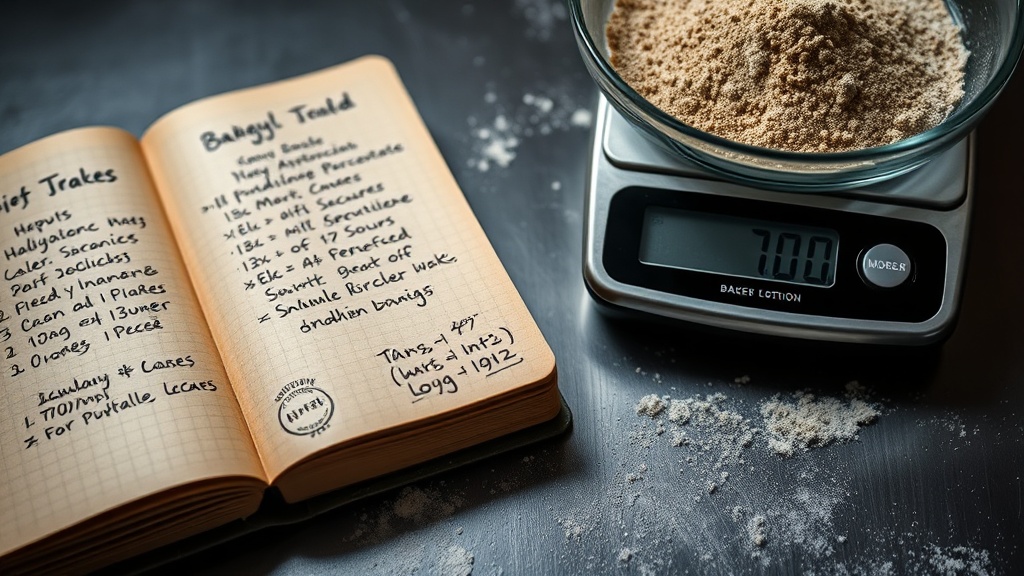
That's the work. It's iterative, it's documented in a notebook (I keep a physical log—yes, like a lab), and it compounds over time. Each test batch gives you a data point. After ten loaves, you know your flour blend's behavior. After twenty, you can predict it.
This ingredient isn't magic. It's a hydrocolloid with defined gel properties that responds predictably to water temperature, concentration, and the competition from other ingredients. Treat it like chemistry and it behaves like chemistry.
Happy baking, but watch your hydration ratios.