The Spring Galette That Broke My Brain (And Then Fixed My Entire GF Pastry Game)

A free-form tart shouldn't be this hard. But gluten-free pastry dough has a reputation problem—and most of it is earned. Here's the Texture Lab formula that finally cracked flaky, foldable, won't-shatter-when-you-look-at-it-wrong GF galette dough.
I need to talk about galettes, because I've been quietly losing my mind over them for six weeks.
Here's the thing about a galette: it's supposed to be the lazy pastry. The "I don't own a pie dish and I refuse to buy one" pastry. You roll out dough, pile something seasonal in the middle, fold the edges up like you're wrapping a mediocre birthday present, and bake. A galette is a pie that went to art school and dropped out. It's perfect.
Unless you're gluten-free.
Then a galette is a crumbly crime scene surrounded by burnt asparagus.
Why GF Galette Dough Fails (A Brief Autopsy)
I've made probably forty failed galettes in the last two years. (Lazarus, my sourdough starter, has watched every single one from the counter with what I can only describe as judgment.) The failure modes fall into three categories:
1. The Shatter. You fold the edges and they crack like dry wall. You try to patch. More cracks. You end up with a flat disc of sadness topped with vegetables. This is what happens when you use a starchy blend (rice flour + tapioca) without enough fat or binder, and the dough has zero extensibility. 2. The Slump. The dough is pliable enough to fold, but it can't hold its shape. You pull it out of the oven and the edges have melted flat into a puddle. Congratulations, you made a very ugly flatbread. This usually means too much xanthan gum or a hydration ratio that turned your pastry into paste. 3. The Cardboard. Structurally perfect. Holds its shape beautifully. Tastes like you laminated a manila folder. This is the classic "1-to-1 flour blend" outcome—technically functional, spiritually dead.I have lived all three of these lives. Multiple times. In the same week.
The Formula That Actually Works
After six weeks of systematic testing (and one truly heroic grocery bill), here's where I landed. This is not a "swap your flour and pray" situation. Every ingredient is doing a specific job.
The Flour Architecture
- 120g sorghum flour — This is load-bearing. Sorghum has a mild, slightly sweet flavor and enough protein to give the dough some actual backbone. It's the closest thing to a "workhorse" flour we have in GF baking, and honestly, the GF world has been sleeping on it.
- 60g tapioca starch — Provides stretch and chew. Without it, sorghum alone makes a crumbly, sandy dough. Tapioca is the ligament holding everything together.
- 40g sweet rice flour (mochiko) — The secret weapon. Mochiko brings a sticky elasticity that mimics some of what gluten does structurally. It's what lets you fold those edges without the dough filing for divorce.
- 1/2 tsp psyllium husk powder (not whole husks—powder) — A thin, invisible web of structure. I've written about psyllium before, and this is exactly the use case it was made for: low-dose structural support that doesn't turn your pastry gummy.
- 1/4 tsp xanthan gum — Yes, both. At these micro-doses, psyllium handles long-range structure while xanthan handles short-range binding. Neither one alone does the job as well as both together at these ratios.
The Fat Situation
- 115g cold unsalted butter, cubed — European style if you can get it (higher fat content = more flake). This goes in frozen and stays in visible chunks. If you can't see butter pieces in your dough, you've overmixed and I'm not responsible for what happens next.
- 1 tbsp cold lard or beef tallow (optional but recommended) — I know. I know. But hear me out: a small amount of animal fat adds a savory depth and a different crystalline structure than butter alone. It makes the crust taste more... serious. More grown-up. If you're plant-based, skip it—the galette will still be excellent. But if you're open to it, the flavor difference is not subtle.
The Liquid
- 3-4 tbsp ice water — Added one tablespoon at a time. The exact amount depends on your flour, your humidity, your altitude, and possibly the phase of the moon. You want the dough to hold together when squeezed but not feel wet.
- 1 tsp apple cider vinegar — Acid tenderizes the dough and inhibits what little protein cross-linking happens in GF flours. It won't taste like vinegar. It'll taste like a crust that actually has layers.
- 1/2 tsp salt
The Method (Read This Before You Touch Anything)
Step 1: Whisk all dry ingredients together. Sorghum, tapioca, mochiko, psyllium, xanthan, salt. Do this in a big bowl. I mean it about the whisking—GF flours clump differently than wheat flour, and uneven distribution means uneven texture. Step 2: Add frozen butter cubes. Cut them into the dry mix using a pastry cutter or your hands (cold hands only—run them under cold water first, you absolute radiator). You want pieces ranging from pea-sized to hazelnut-sized. The big ones create steam pockets during baking. The small ones create tenderness. You need both. Step 3: Add lard/tallow if using. Work it in briefly. It should disappear into the flour more than the butter does. Step 4: Add vinegar to ice water. Drizzle in one tablespoon at a time, mixing with a fork after each addition. Stop when the dough holds together when squeezed. It will look shaggy and slightly terrifying. This is correct. Step 5: Form a disc, wrap in plastic, refrigerate for at least 1 hour. Two hours is better. Overnight is ideal. The psyllium needs time to hydrate and build its structural network. Rushing this step is the number-one reason people tell me "your recipe didn't work." It worked. You didn't wait. Step 6: Roll between two sheets of parchment. Not on a floured surface—the dough will absorb the loose flour and dry out. Parchment on both sides. Roll to about 12 inches across and 1/4 inch thick. If it cracks at the edges, let it warm up for 3 minutes and try again. Patience. Patience. Step 7: Fill and fold. Leave a 2-inch border. Pile your filling in the center (see below). Fold the edges up, overlapping as you go. The dough should fold without cracking. If it cracks, you either didn't hydrate long enough or your kitchen is the Sahara. Brush the edges with an egg wash (or oat milk for dairy-free) and hit it with flaky salt. Step 8: Bake at 400°F (200°C) for 35-40 minutes. The edges should be deep golden brown—not "lightly tanned," golden brown. GF pastry needs the color. Underbaked GF crust tastes like paste.The Spring Filling (Because It's Finally Asparagus Season)
I'm keeping the filling simple because the dough is the star here, but also because asparagus doesn't need much help:
- 1 bunch asparagus, woody ends snapped off, cut into 2-inch pieces
- 4 oz chèvre (goat cheese), crumbled — naturally GF, tangy, and melts into gorgeous puddles
- 1 lemon, zested
- 2 tbsp olive oil
- Fresh thyme leaves
- Flaky salt, black pepper
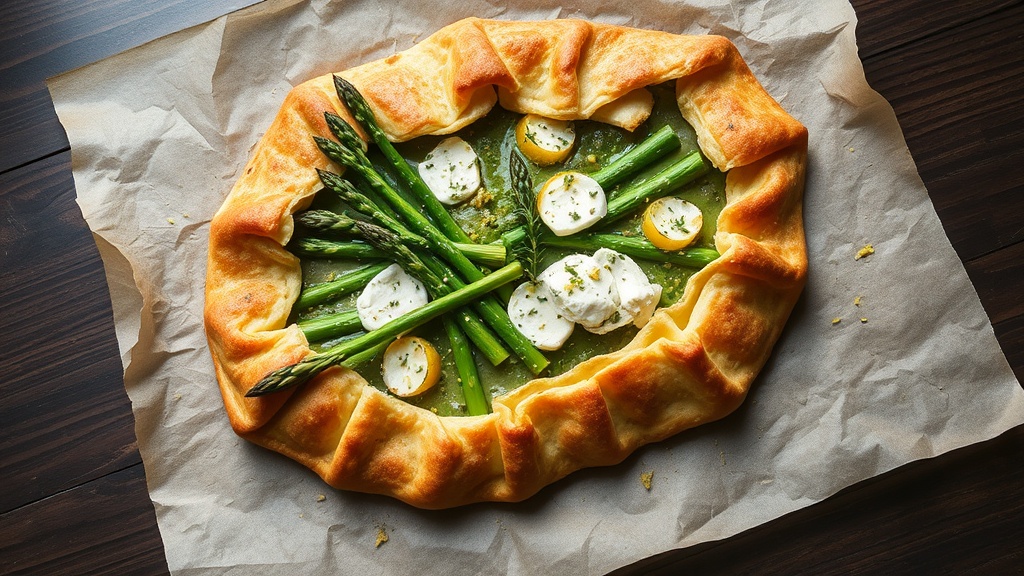
Spread the chèvre across the center of the dough. Layer asparagus on top. Drizzle with olive oil, scatter thyme and lemon zest. Fold, wash, salt, bake.
When it comes out of the oven, the edges will be shattery-crisp and the bottom will be firm but tender. The asparagus will be charred at the tips and bright green in the middle. The chèvre will have melted into savory pools between the spears.
This is not a "pretty good for gluten-free" galette. This is a galette.
What I Learned From Forty Failures
The GF pastry problem isn't really a flour problem. It's an architecture problem.
Wheat dough has gluten, which is simultaneously the structure, the binder, and the source of extensibility. It's a one-ingredient engineering miracle. When you remove it, you can't replace it with one thing. You have to rebuild the system from components: sorghum for structure, tapioca for stretch, mochiko for elasticity, psyllium for long-range bonding, xanthan for short-range cohesion, fat for flakiness, acid for tenderness.
It's more work. It requires understanding what each ingredient actually does rather than just dumping in a "1-to-1 blend" and hoping. But when it works—when you pull a galette out of the oven and the edges are golden and the filling is bubbling and you can fold a slice without it disintegrating—it's worth every single test batch.
And Lazarus still judges me. But I think he's impressed.
Have a galette win (or crime scene) to share? I want to see it. Tag me or drop a comment—especially if you tried the beef tallow. I need to know if I'm alone in this.