The Xanthan Equation: Perfecting Texture in Gluten-Free Sauces and Gravies

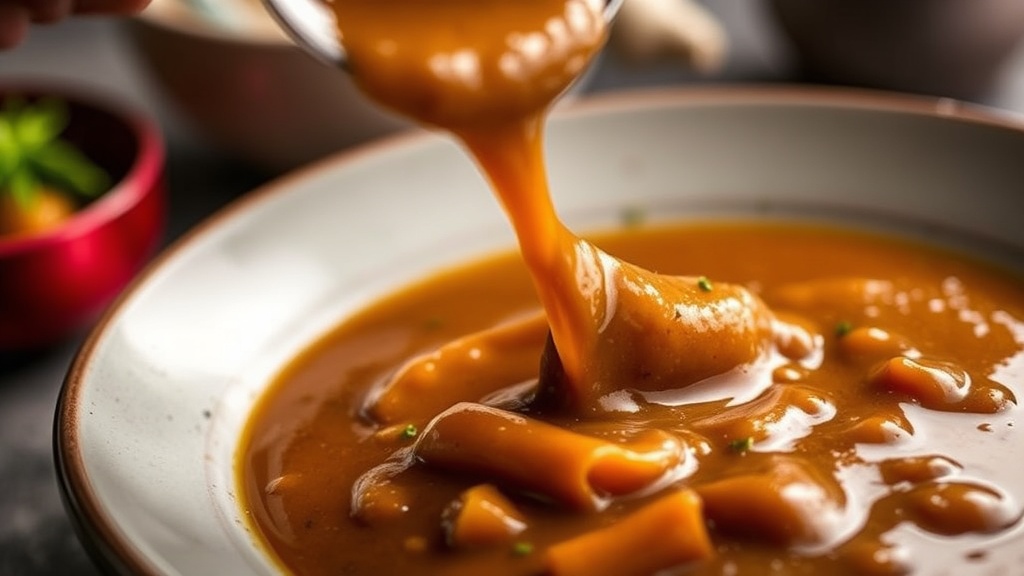
A single drop of translucent, amber-colored liquid hangs suspended from a silver spoon, refusing to break. It clings to the metal with a stubborn, viscous tension before finally collapsing into a pool on a white porcelain plate. This is the hallmark of a well-emulsified sauce—a texture that coats the back of a spoon without feeling heavy, slick, or unpleasantly gelatinous. In the gluten-free kitchen, achieving this specific level of "cling" is the difference between a professional-grade reduction and a watery, disjointed mess.
The culprit behind most failed gluten-free sauces is the absence of a structural protein network. In traditional cooking, wheat flour provides the starch and protein necessary to bind liquids and create a velvety mouthfeel. Without gluten, we must rely on hydrocolloids—specifically xanthan gum—to replicate that physical architecture. However, xanthan gum is a precision tool, not a blunt instrument. Use too little, and your gravy remains a thin, translucent liquid; use too much, and you create a texture reminiscent of commercial hair gel.
The Science of the Hydrocolloid
Xanthan gum is a polysaccharide produced through the fermentation of glucose by the bacterium Xanthomonas campestris. In the culinary context, it acts as a stabilizer and thickener by increasing the viscosity of a liquid. Unlike cornstarch, which relies on heat-induced gelatinization to thicken, xanthan gum is remarkably stable across a wide range of temperatures and pH levels. This makes it indispensable for everything from hot pan gravies to cold vinaigrettes.
The primary function of xanthan in a sauce is to provide "pseudoplasticity." This is a fancy way of saying the sauce will behave like a solid when at rest but will flow smoothly when subjected to shear force—such as when you pour it or stir it. This is why a xanthan-stabilized sauce can feel luxurious on the tongue but doesn't feel "clumpy" or "sludgy" while being served.
The Three Pitfalls of Over-Reliance
Before adjusting your ratios, you must recognize the three most common errors encountered when working with this additive:
- The "Slime" Factor: Excessive amounts of xanthan gum create a stringy, mucus-like texture. This often happens when the gum is not properly dispersed, leading to localized "clumps" of high viscosity.
- The Flavor Mask: While xanthan is largely neutral, high concentrations can create a subtle, unpleasant "slickness" on the palate that coats the tongue and masks the delicate nuances of high-quality fats or acids.
- The Texture Paradox: If you use too much xanthan in a sauce intended for a delicate protein, such as a lemon-butter sauce for sea bass, the sauce will feel unnaturally heavy and "artificial" compared to the lightness of the fish.
The Perfect Ratio: A Step-by-Step Protocol
To master the xanthan equation, one must move away from "pinches" and toward weight-based precision. A kitchen scale is your most important tool here. For most sauces and gravies, the target concentration is between 0.1% and 0.5% of the total weight of the liquid.
Step 1: The Dispersion Method (Preventing Clumps)
The biggest mistake is adding xanthan gum directly to a hot liquid. This results in "fish eyes"—small, undissolved lumps of gel that are nearly impossible to remove. To prevent this, use the Oil Dispersion Technique. Take a small portion of the fat intended for your sauce (such as the rendered fat from a pan of bacon or a tablespoon of extra virgin olive oil) and whisk the xanthan gum into the fat first. This coats the individual particles of the gum in lipids, preventing them from hydrating instantly and clumping upon contact with water or stock.
- Prepare your base: Bring your stock or cream to a simmer.
- Create the slurry: In a separate small ramekin, mix 1/2 teaspoon of xanthan gum with 1 tablespoon of room-temperature oil or a neutral oil like grapeseed.
- Incorporate: Slowly whisk the oil-gum mixture into the simmering liquid.
- Wait for activation: Allow the sauce to simmer for at least 2 minutes. Xanthan gum requires a moment of kinetic energy and heat to fully hydrate and reach its maximum viscosity.
Step 2: Calibrating for Sauce Type
Different sauces require different levels of structural integrity. Use the following guidelines as a baseline for your experimentation:
- Light Vinaigrettes & Emulsions: Aim for 0.1% to 0.2%. You want enough to keep the oil and vinegar from separating, but not enough to make the dressing thick.
- Classic Pan Gravies (Beef or Chicken): Aim for 0.3% to 0.4%. This provides the "cling" necessary to coat a roasted chicken or a steak without the heaviness of a traditional roux-based gravy.
- Heavy Cream Sauces (Béchamel or Mornay): Aim for 0.5%. Since you are already using fats and starches (like arrowroot or tapioca), the xanthan serves as a secondary stabilizer to ensure the sauce remains smooth during temperature shifts.
Advanced Techniques: Combining Hydrocolloids
In high-end gluten-free cooking, we rarely rely on xanthan gum alone. The most sophisticated textures are achieved through "hybrid thickening." By combining xanthan with other starches or gums, you can manipulate the mouthfeel with surgical precision.
For instance, if you are making a rich, savory gravy, pairing xanthan gum with Arrowroot Powder creates a superior result. Arrowroot provides a clean, glossy finish and a slight "snap" in viscosity, while the xanthan ensures the sauce remains stable even if it cools slightly. This is a technique often used when balancing hydration in complex recipes, as it manages the relationship between water and solids more effectively than starch alone.
Another powerful combination is Xanthan and Tapioca Starch. This is ideal for vegetable-heavy sauces or purees. The tapioca adds a creamy, slightly elastic quality, while the xanthan prevents the vegetable water from separating and pooling at the bottom of the dish. This is particularly useful when working with high-moisture vegetables like squash or cauliflower.
Troubleshooting Your Sauce
Even with a scale and a dispersion method, variables like temperature and acidity can throw off your equation. Here is how to diagnose and fix a sauce that has gone wrong:
If the sauce is too thin: Do not simply add more xanthan. If you do, you risk the "slime" texture. Instead, try a "re-emulsification." Take a small amount of the liquid, whisk in a tiny amount of xanthan and a starch (like cornstarch or arrowroot), and then slowly whisk that back into the main pot. The starch will provide the body, while the xanthan provides the stability.
If the sauce is too thick or "rubbery": This is usually a sign of over-hydration. To fix this, you must dilute. However, do not just add water, as this will dilute the flavor. Instead, add a highly flavored liquid, such as a fortified bone broth, a splash of dry white wine, or a squeeze of lemon juice. This restores the viscosity and the flavor profile simultaneously.
If the sauce is "broken" (Oil and liquid have separated): This is a failure of emulsion. If you used xanthan, the separation is likely due to an imbalance of temperature or an insufficient amount of the gum. To fix a broken sauce, whisk in a teaspoon of warm water or a neutral oil, and use a high-speed immersion blender to force the emulsion back together. The xanthan should act as the "glue" to hold the new emulsion in place.
The Professional Standard
True culinary mastery in the gluten-free world is not about finding a "replacement" for wheat; it is about understanding the physics of what wheat does and replicating it with better, more precise ingredients. When you treat xanthan gum as a scientific variable rather than a mystery powder, you move from the realm of "substitution" into the realm of "creation." Your sauces will no longer be an afterthought; they will be the foundation of a truly dignified, professional-grade meal.